
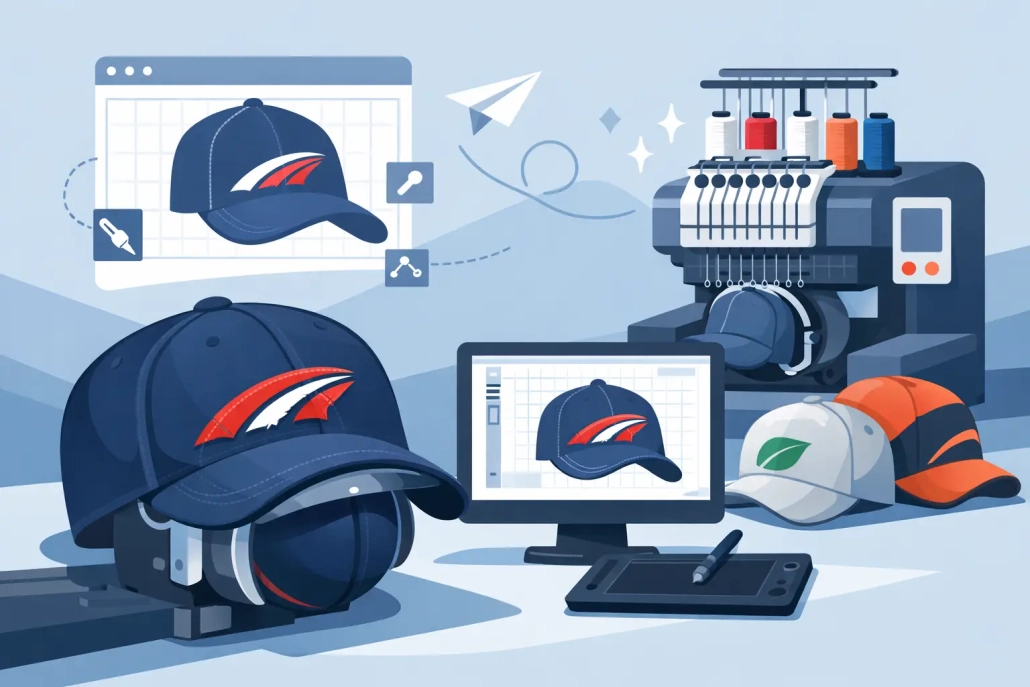
Cap Embroidery Digitizing Service That Delivers
A cap run can fall apart fast when the file is not built for the hat. Lettering closes up, curves flatten, and push-pull distortion shows up right across the front panel. That is why a cap embroidery digitizing service is not just another artwork step. It is production prep that directly affects stitch quality, machine time, and whether an order ships on schedule.
For embroidery shops, apparel decorators, and promotional product suppliers, caps are one of the most common and most unforgiving products in the lineup. The sewing field is smaller, the structure is tighter, and the center seam changes how a design behaves. A file that runs well on a flat left chest often performs poorly on a cap. Good cap digitizing accounts for that from the start.
What makes cap digitizing different
Cap embroidery has its own rules. The crown shape, the front seam, the cap frame, and the direction of sew-out all influence the final result. A design that looks balanced on screen may still stitch unevenly if the underlay, stitch angles, density, and sequence are not built specifically for cap application.
The biggest issue is structure. Caps are curved and often reinforced in the front, which means stitches do not land the same way they do on a flat garment panel. Small text, thin outlines, and tight details can shift or sink if the file is not planned properly. That is why cap files usually need stronger compensation, cleaner pathing, and smarter sequencing than general embroidery files.
There is also the matter of run direction. Many cap designs are digitized to sew from the center out to reduce registration problems and help stabilize the garment during embroidery. That sounds simple, but it affects the whole file. Elements need to be broken apart and rebuilt with the machine and the cap frame in mind, not just the artwork.
Why a cap embroidery digitizing service matters to production
If you manage production, you already know the real cost of a weak file. It is not just one bad sample. It is wasted caps, machine downtime, thread breaks, quality checks, operator frustration, and delivery risk. On repeat orders, those costs compound quickly.
A professional cap embroidery digitizing service helps avoid that by building files for actual production conditions. The goal is not just to convert artwork into stitches. The goal is to create a file that runs cleanly, holds detail where possible, and gives operators fewer surprises on the machine.
That matters even more when your shop handles volume. One-off trial and error might be tolerable on a small internal project, but it does not scale for customer deadlines. Reliable outsourced digitizing gives shops a more predictable workflow, especially when cap orders come in alongside left chest logos, jacket backs, and patches.
What a strong cap file should deliver
A good cap file starts with readability. Text should remain open, satin columns should hold their shape, and fills should support the design without overpowering it. Clean sequencing matters too. Poor sequencing can create unnecessary trims, registration issues, and extra machine handling.
Underlay is another major factor. On caps, underlay has to stabilize without adding bulk that makes the top stitching look heavy. Density also has to be controlled carefully. Too light, and the design looks weak. Too dense, and the cap can pucker, especially around structured panels and seams.
Trade-offs are part of the job. Not every detail in a source logo belongs in a cap design at its original size. Sometimes the smartest choice is simplifying small elements so the embroidered result looks sharper and runs better. Experienced digitizers know when to preserve detail and when to adapt it for the garment.
Common problems caused by poor cap digitizing
Most cap embroidery issues can be traced back to file preparation. Designs with tiny lettering often fill in because the columns are too narrow for the stitch type. Circular logos can distort because the file does not account for cap curvature. Outlines drift when sequencing is inefficient or compensation is off.
Another common problem is over-digitizing. Some files look impressive in software because they include heavy detail and layered stitch effects, but they perform badly in production. Caps do not reward excess. They reward control, balance, and a practical understanding of how thread interacts with structured headwear.
Shops also run into trouble when they use flat-garment files on caps to save time. That shortcut usually costs more later. A left chest file and a cap file may come from the same logo, but they should not be treated as interchangeable.
Who benefits most from outsourced cap digitizing
A specialized cap embroidery digitizing service is especially valuable for businesses that need consistency at speed. Embroidery shops with tight schedules benefit because they can move from artwork approval to machine setup faster. Promotional product distributors benefit because branded cap orders often come with fixed event deadlines and little room for rework.
Print shops and apparel decorators expanding into embroidery also gain an advantage. Instead of trying to build in-house digitizing capacity for every product type, they can outsource cap work to specialists and keep their focus on sales, fulfillment, and customer management. For growing businesses, that is often the more efficient move.
Even experienced embroidery operations use external support when order volume spikes. The question is not whether your team understands embroidery. The question is whether your current workflow can absorb cap-specific digitizing without slowing down production.
What to look for in a cap embroidery digitizing service
Speed matters, but not by itself. A fast turnaround only helps if the file is production-ready. Look for a provider that understands cap-specific stitch strategy, not just general logo conversion. The service should be able to work from common customer artwork formats, make practical adjustments when artwork is not ideal, and deliver files that reduce machine-side corrections.
Pricing transparency matters too. Shops need to quote confidently and protect margins. Flat-rate structures for common cap designs can make planning easier, especially for repeat work. Support availability is another real factor. Orders do not always land during office hours, and production teams often need updates or revisions outside the usual schedule.
Consistency is what turns a vendor into a production partner. If the first file looks good but the next five are unpredictable, your workflow still suffers. The right service should help you maintain quality across repeat logos, rush orders, and mixed garment programs.
Why turnaround time matters more on caps
Cap orders are often tied to launches, events, team deliveries, and promotions. When artwork approval runs late, production time gets squeezed. That is where responsive digitizing support can make a measurable difference.
A 3-to-4-hour turnaround on standard cap work can help shops keep machines running instead of waiting on files. It also gives more room for test sew-outs and minor revisions before the order reaches the critical stage. Fast service is not just a convenience. It protects your production calendar.
That said, speed should not mean skipping judgment. Some logos need edits to work on caps. Some customer expectations need to be managed before the file is built. A strong service moves quickly while still making the calls that protect final quality.
The business case for getting cap files right the first time
Every embroidery business wants to improve margin, but margin is not only about lowering upfront cost. It is about reducing avoidable waste. A well-digitized cap file saves time on setup, cuts down on rejected samples, and supports more efficient machine operation.
It also helps protect customer trust. End buyers may not know what digitizing is, but they notice when lettering looks muddy or the logo pulls off center. Quality issues on caps stand out because the decoration sits front and center. When the file is right, the finished product looks more premium, and your shop looks more dependable.
That is where a service-focused partner adds value. UltraEMB supports embroidery businesses that need cap-ready files delivered quickly, at reasonable rates, and with the kind of consistency that helps production teams stay competitive.
Cap embroidery digitizing service for growing shops
As order volume grows, file quality becomes less of an art-room issue and more of an operations issue. You need cap designs that run reliably across repeat jobs, different cap styles, and varying order sizes. You also need support that keeps pace when customers place last-minute requests or send artwork that is less than perfect.
A dependable cap embroidery digitizing service gives growing shops room to scale without building extra internal pressure. It keeps quoting simpler, scheduling tighter, and production more predictable. That matters whether you are handling ten caps for a local brand or hundreds for a national promotion.
The smartest production systems are built on fewer surprises. When your cap files are prepared correctly, your machines run better, your team moves faster, and your customers see the difference where it counts most – on the finished hat.
 +1 (208) 473-5575 Extension #800
 +44 191 308 5011
 designs@ultraemb.com


Leave a Reply
Want to join the discussion?Feel free to contribute!