
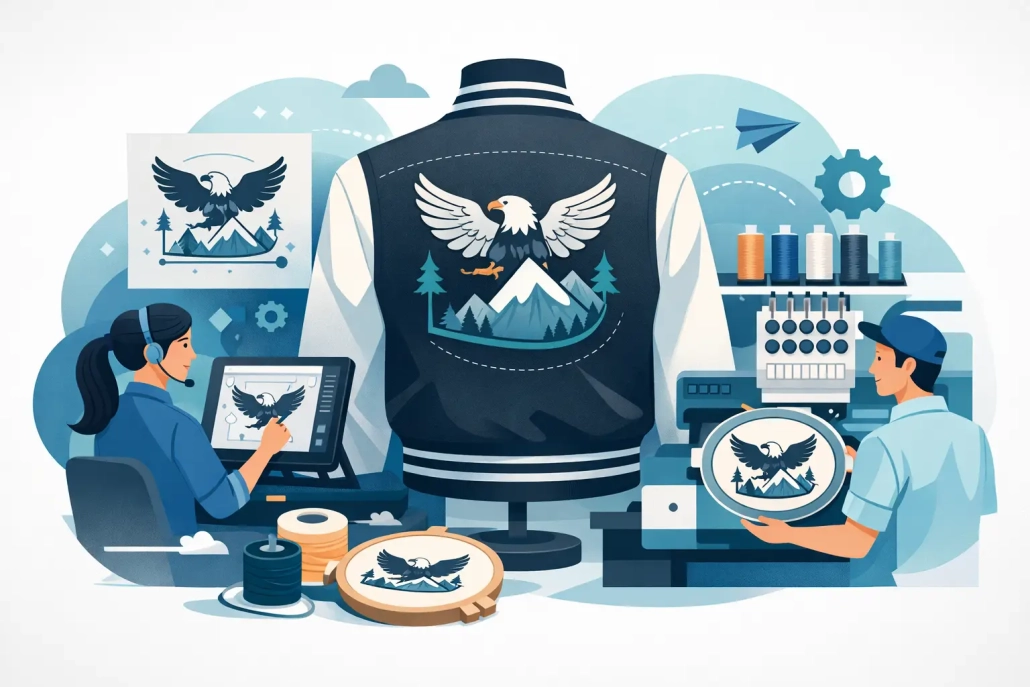
Jacket Back Digitizing Service That Delivers
Big jacket back designs can make a shop look great or create a production headache fast. That is exactly why a reliable jacket back digitizing service matters. When the design area is wide, stitch counts climb, fabric behavior changes, and small digitizing mistakes become expensive on the machine.
For embroidery businesses and apparel decorators, jacket backs are not just larger versions of left chest logos. They require a different approach to stitch flow, underlay, density, compensation, and sequencing. If the file is built without that level of control, you see thread breaks, registration issues, puckering, uneven fills, and sew-outs that slow your whole schedule.
What a jacket back digitizing service should actually solve
A professional jacket back digitizing service should do more than convert artwork into an embroidery file. Its real job is to prepare a large-format design so it runs cleanly in production, holds its shape on the garment, and gives your customer a finished result worth repeating.
That starts with understanding scale. Jacket backs often include broad fill areas, detailed lettering, gradients interpreted through stitch techniques, and long stitch paths that need careful planning. On top of that, jackets themselves are not simple surfaces. Satin varsity jackets, fleece outerwear, work jackets, and lightweight promotional pieces all react differently under the needle.
A production-ready file accounts for those variables before the first sew-out begins. That means proper push and pull compensation, sensible density, clean travel paths, and a sequence that reduces trim points where possible. It also means digitizing for the fabric, not just for the image on screen.
Why jacket back digitizing is more technical than standard logo work
Large embroidery has less room for guesswork. A left chest file might still run acceptably if the digitizing is average. A jacket back usually will not. The larger the design, the more obvious every weakness becomes.
Stitch count is one factor, but it is not the only one. The real challenge is balance. Heavy fills can distort the garment if they are packed too tightly. Fine detail can disappear if it is scaled improperly. Text that looks clean in artwork may need to be simplified, reshaped, or stitched with a different method to stay readable on fabric.
There is also the issue of hooping and garment stability. A file may be technically correct but still perform poorly if the digitizing ignores how the jacket shifts during sewing. Experienced digitizers build with movement in mind. They understand where distortion is likely to happen and reduce the risk in the file itself.
That is why shops that handle team wear, corporate outerwear, fashion pieces, and promotional jackets often outsource this work. It saves production time and avoids repeated edits that eat into margins.
Large design areas need clean stitch logic
Jacket backs can involve logos, mascots, emblems, names, slogans, and layered design elements all in one layout. If those parts are digitized independently without a clear stitching strategy, the result is messy. Elements fight for space, outlines drift, and the design loses visual control.
Good digitizing organizes the artwork into a smart sewing path. It keeps fills stable, protects borders, and supports details without making the design overly dense. That balance is what helps a file run well on repeat orders, not just on one test piece.
Fabric type changes the file
A satin jacket back and a heavyweight canvas jacket back should not automatically receive the same stitch treatment. Slick fabrics may show needle penetration and shifting more easily. Thicker outerwear may support heavier stitching but still need thoughtful underlay to keep large sections even.
This is where a specialized service adds real value. The file should be adjusted to the garment category, not processed like a generic embroidery order. That extra care helps reduce spoilage and gives production teams more confidence at the machine.
What buyers should expect from a dependable service partner
If you are outsourcing jacket back embroidery files, speed matters, but speed without consistency is not much help. A dependable partner should be able to deliver fast turnaround while still building files that are practical for real production.
That means clear communication on artwork quality, sizing, stitch count expectations, and any design limitations before the job becomes a problem. Some jacket back art needs cleanup or simplification. Some designs need vector conversion first. Some can be stitched beautifully but only if the customer understands the trade-off between detail and readability.
The best service partners do not pretend every artwork file is perfect as-is. They identify what will work, what needs adjustment, and how to get to a strong final result without wasting time.
For many shops, predictable pricing is just as important as technical quality. Large designs can vary widely in complexity, so transparency matters. If a digitizing provider is vague about turnaround or cost, that uncertainty can spill directly into your production schedule and client quotes.
How a strong jacket back digitizing service supports growth
Outsourcing is not only about convenience. For many decorators, it is a smart capacity decision. Jacket back jobs can consume a lot of internal attention, especially when staff is already focused on machine scheduling, approvals, client communication, and fulfillment.
A skilled jacket back digitizing service gives your business room to take on more work without building a full in-house digitizing team. That matters for growing shops, seasonal rush periods, and businesses managing multiple decoration types at once.
It also helps standardize quality. When your files are created by experienced digitizers who understand large-format embroidery, you spend less time correcting avoidable issues. That can improve turnaround, reduce material waste, and support more confident quoting on repeat programs.
For production managers, the benefit is operational. For shop owners, the benefit is margin protection. For agencies and brand suppliers, the benefit is reliability when client expectations are high.
Common problems caused by weak jacket back digitizing
Most embroidery shops have seen the same pattern. The artwork looks good, the machine starts, and then the file begins creating problems halfway through the run. The design shifts, fill areas bunch up, outlines fail to land cleanly, and thread trims become excessive.
Those issues are usually rooted in the digitizing itself. Poor sequencing can cause registration trouble. Excessive density can create stiffness and puckering. Inadequate underlay can leave fills uneven. Small lettering pushed beyond realistic embroidery limits can turn into unreadable stitching.
Not every design can be embroidered exactly as submitted. That is one of the most important realities to accept. The right service partner knows when to preserve detail and when to adapt the artwork for a better sew-out. In production, that practical judgment matters more than screen-perfect appearance.
Fast turnaround still needs production discipline
Quick delivery is valuable, especially when clients need approvals and garments are already on the floor. But rushed files that require multiple revisions are not truly fast. A strong provider combines turnaround speed with disciplined digitizing standards.
That is where a company like UltraEMB fits well for busy shops. The focus is not only on turnaround, but on delivering workable files for real production environments where deadlines, quality control, and repeat business all matter.
Choosing the right outsourced partner for jacket backs
The best choice is usually a service built around commercial embroidery workflows, not a general design vendor trying to offer digitizing as a side service. You want a team that understands stitch behavior, garment challenges, and production realities from the start.
Look for a partner that can handle volume, communicate clearly, and maintain quality across different design styles. Sportswear graphics, corporate branding, biker club layouts, fashion back pieces, and promotional jacket designs all bring different digitizing demands. A qualified provider should be comfortable adjusting to those variations.
It also helps to work with a service that is available when your production day does not follow a neat schedule. Shops often receive art late, approvals change, and clients ask for edits outside standard office hours. Responsive support can make the difference between staying on track and missing ship dates.
A good jacket back file should reduce stress, not create another layer of troubleshooting. That is the standard worth paying attention to.
The real value of a production-ready file
A production-ready embroidery file protects more than stitch quality. It protects labor time, garment costs, delivery dates, and customer trust. When jacket back jobs run smoothly, your team can focus on output instead of repair work.
That is why serious decorators do not treat digitizing as a minor prep step. They treat it like a core part of production. The better the file, the better the run, and the easier it is to keep clients coming back for the next order.
If jacket back embroidery is part of your business, the smartest move is simple: use a jacket back digitizing service that understands scale, fabric, and machine performance well enough to help you produce with confidence.
 +1 (208) 473-5575 Extension #800
 +44 191 308 5011
 designs@ultraemb.com


Leave a Reply
Want to join the discussion?Feel free to contribute!