
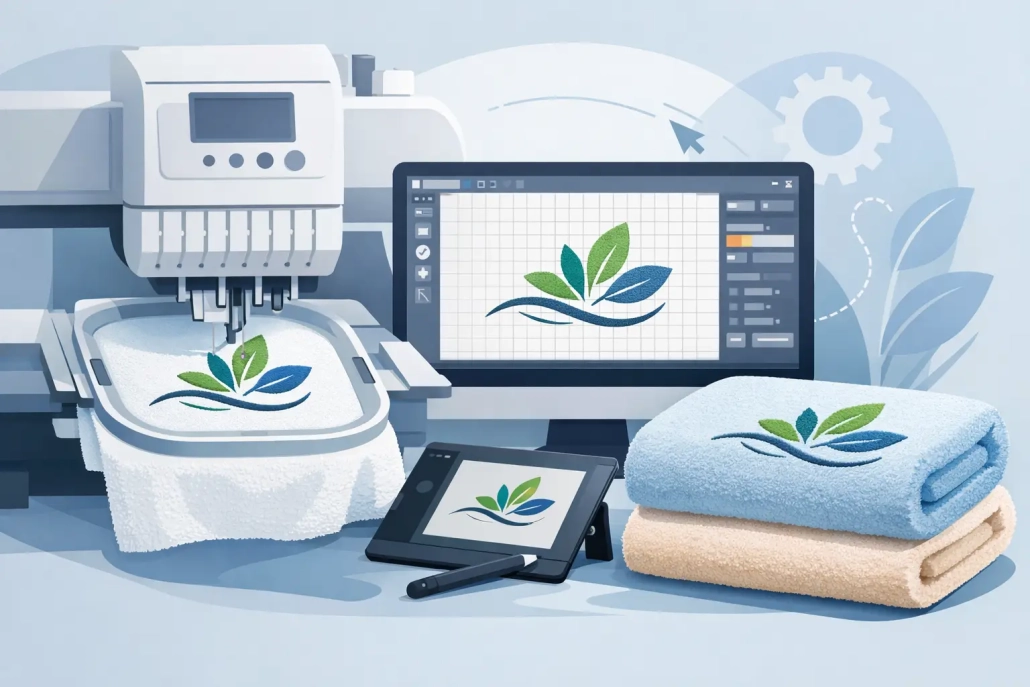
Towel Embroidery Digitizing Service That Works
A logo that looks sharp on a polo can fall apart fast on a towel. Terry cloth has height, texture, and movement, which means standard embroidery settings often produce buried details, uneven fills, and lettering that loses clarity. That is exactly why a professional towel embroidery digitizing service matters. If you decorate towels for resorts, gyms, spas, golf events, promo campaigns, or retail programs, the file has to be built for the fabric, not just converted for embroidery.
Towels are one of the easiest products to underestimate in production. At first glance, they seem simple – large imprint area, familiar material, straightforward branding. In practice, towel embroidery creates a different set of technical demands than caps, jackets, or left chest logos. The pile can swallow small elements, outlines can break up, and stitch density that works on flatter garments can create distortion or excessive push and pull.
Why towel embroidery digitizing service is different
A towel embroidery digitizing service is not just about turning artwork into a machine-readable file. It is about deciding how that artwork should be reinterpreted for thick, textured fabric. Good digitizing for towels accounts for nap direction, underlay strategy, stitch types, density balance, compensation, and readability at finished size.
That changes the way experienced digitizers approach the design. Fine serif lettering may need adjustment. Thin outlines may need to be opened up or simplified. Small negative spaces often need to be enlarged so they do not close during stitching. Even the sequence matters more than many buyers expect, because towels can shift and react differently during runs, especially at higher machine speeds.
For production teams, the real issue is not whether a design can be stitched. It is whether it can be stitched cleanly, repeatedly, and without wasting time on edits, test sew-outs, or operator intervention. A file that looks acceptable on screen but performs poorly on terry cloth becomes expensive very quickly.
What a strong towel file needs to do
On towels, clarity beats complexity. The file should preserve the brand identity, but it also needs to respect the limits of the surface. That usually means using stitch structures that sit above the pile instead of disappearing into it, along with underlay that lifts the top stitching and helps create definition.
Column width is another common issue. Narrow satin elements may not hold well unless they are adjusted for the towel base. Fill areas also need careful control. If density is too heavy, the design can look stiff and pucker. If it is too light, coverage can look weak and inconsistent. There is no universal setting that fixes this. It depends on the towel type, design size, and level of detail in the artwork.
Lettering deserves special attention. Names, monograms, resort branding, and corporate marks are common on towels, but small text is often where production quality drops first. A reliable digitizing file protects legibility by choosing the right stitch type, spacing characters properly, and reducing unnecessary detail before it becomes a stitching problem.
The production risks of poor digitizing
When towel digitizing is done poorly, the problems show up fast. You may see loops peeking through the top stitching, uneven edge definition, gaps in coverage, or registration issues between colors. In some cases, the design simply looks dull because the texture of the towel overpowers the embroidery.
That creates more than a cosmetic problem. It affects spoilage, machine time, labor, and customer confidence. A production manager dealing with deadlines does not want to stop a run because the logo needs editing after the first sample. A shop owner does not want to explain to a client why their premium towels look rough while the mockup looked crisp. A low-cost file can become the most expensive part of the order if it creates delays.
This is where outsourced specialization has real value. When a digitizer understands towel construction, the file is built to reduce preventable problems before the run starts. That means fewer revisions, better stitch-outs, and a smoother production cycle for your team.
What buyers should expect from a towel embroidery digitizing service
Speed matters, but only if the file is usable. The best towel embroidery digitizing service combines fast turnaround with fabric-specific decision-making. That means the digitizer reviews the logo not just as artwork, but as a production job. They should identify where detail needs simplification, where stitch angles should shift, and how underlay will support the final result on terry cloth.
Consistency also matters. If you handle repeat orders for hospitality groups, sports clubs, promotional distributors, or private-label programs, you need files that run predictably across batches. Consistent digitizing helps maintain the same visual quality from one towel style to the next, even when the item changes in thickness or finish.
Support is another practical factor. Sometimes the file needs a minor adjustment based on hoop size, placement area, or customer expectations. A responsive service partner makes that easier. For busy shops, access to reliable help is not a bonus. It is part of keeping production on schedule.
Pricing transparency matters too. Many embroidery businesses outsource because it is more efficient than building in-house digitizing capacity for every specialty application. Flat-rate or clearly structured pricing makes estimating easier and protects margins when towel jobs come in with short lead times.
When standard logo digitizing is not enough
Some buyers assume a left chest file can be reused on a towel with little or no change. Sometimes that works for bold, simple marks. Often, it does not. Towels introduce enough texture that even a good general embroidery file may need reworking to hold definition and coverage.
This is especially true for hospitality branding, spa logos, event merchandise, and premium retail towel programs where the finished look carries a lot of perceived value. On these jobs, embroidery quality is part of the product, not just decoration. If the design looks flat, crowded, or inconsistent, the item feels less premium.
There is also a scale issue. Towels can accommodate larger logos and decorative treatments, but scaling up a file is not always a clean solution. Larger size may expose weak sequencing, density imbalance, or awkward fill behavior. Specialty digitizing helps the design perform at the actual production size rather than relying on assumptions from another garment category.
A practical outsourcing advantage for busy shops
For embroidery businesses and apparel decorators, outsourcing towel digitizing is often the fastest way to stay efficient without compromising output. Specialty jobs tend to interrupt workflow when handled internally, especially if your team is already focused on quoting, scheduling, machine operation, and customer communication.
A dedicated service partner reduces that pressure. Instead of experimenting with file edits or spending extra time on sew-out troubleshooting, your team can move directly into production with greater confidence. That is particularly useful during seasonal volume spikes, event deadlines, or high-mix order periods when one difficult design can slow down the entire floor.
UltraEMB serves shops that need this kind of production support – fast files, reasonable rates, and dependable execution for specialized embroidery applications such as towels.
How to judge file quality before a full run
The easiest test is not the screen preview. It is the sew-out. Look for clean edge definition, visible detail above the pile, balanced coverage, and readable lettering at final size. The embroidery should look intentional, not forced onto the fabric.
Also pay attention to how the file behaves operationally. Does it run efficiently? Does it avoid unnecessary trims and abrupt transitions? Does it hold up without constant tweaking? Good towel digitizing supports both appearance and production flow.
If revisions are needed, that does not automatically mean the file was poor. Towel styles vary, and some designs need fine-tuning based on the specific substrate. What matters is whether the original file was built with the right technical logic and whether support is available when adjustments make sense.
A dependable towel embroidery digitizing service gives you more than a file. It gives you a better shot at clean production, stronger presentation, and fewer avoidable setbacks on textured goods. When the substrate is challenging and the deadline is real, that kind of preparation is what keeps the order moving.
 +1 (208) 473-5575 Extension #800
 +44 191 308 5011
 designs@ultraemb.com


Leave a Reply
Want to join the discussion?Feel free to contribute!