
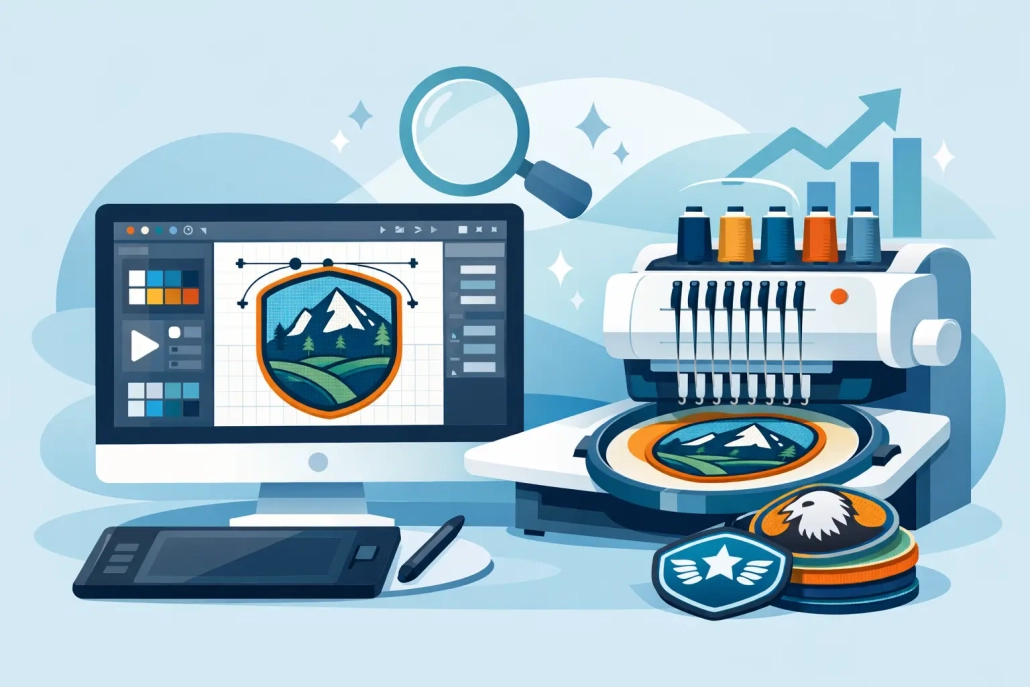
Patch Digitizing Service That Gets Results
A patch that looks sharp on screen can still fail on press if the stitch file is built the wrong way. That is why a reliable patch digitizing service matters. When you are producing embroidered patches for uniforms, retail drops, teamwear, workwear, or promotional orders, every detail in the file affects run quality, edge definition, thread coverage, and delivery time.
Patch embroidery is less forgiving than many standard logo applications. The border has to hold. Small text has to stay readable. Fill areas need to sit cleanly inside a defined shape without pushing or distortion. If the digitizing is off, the patch may look heavy, uneven, or inconsistent from piece to piece. For shops that sell finished goods on deadlines, that is not a small issue. It affects rework, waste, margins, and customer confidence.
Why patch digitizing service matters in production
A good patch file is not just a converted logo. It is a stitch plan built for a very specific product type. Patches behave differently than left chest embroidery or cap embroidery because they often involve tighter borders, denser fills, cleaner shape control, and a stronger visual emphasis on the edge.
This is where many production problems begin. Artwork that looks simple can become difficult once it is translated into stitches on twill, felt, or other patch bases. Curves can flatten out. Lettering can close up. Borders can wobble if the underlay and stitch path are not handled properly. A professional patch digitizing service accounts for those issues before the file reaches your machine.
For embroidery businesses and apparel decorators, that means fewer surprises in sampling and a smoother path to final production. You are not just buying a file. You are buying predictability.
What separates a strong patch digitizing service from a basic one
Speed matters, but speed without control creates more work later. The real value is in getting a file that runs cleanly and supports your shop’s workflow.
A strong patch digitizing service starts by reading the artwork with production in mind. That includes evaluating border thickness, stitch direction, sequence, compensation, lettering size, and how the design will hold up at the intended patch dimensions. Some designs need cleanup or simplification before digitizing starts. Others need certain elements adjusted so the final patch still looks true to the brand without becoming unstable in production.
This is especially important for shops handling repeat orders or customer programs. If one patch run looks different from the next, the issue often traces back to file quality, not machine capability alone. Consistent digitizing supports consistent output.
There is also a practical business side to this. If your team spends extra time editing stitch files, testing bad files, or explaining delays to customers, the real cost of cheap digitizing goes up fast. A service that delivers usable files quickly can save more than it costs.
Patch digitizing service for different patch styles
Not every patch is built the same way, and that affects digitizing decisions. A file for a merrow border patch is not approached exactly like a file for a laser-cut or satin border patch. The edge treatment changes how the design should be balanced inside the shape.
For traditional embroidered patches, the border usually needs to be bold enough to frame the design and protect the shape. For detailed patches with fine lettering or emblem-style artwork, spacing becomes critical. If elements are packed too tightly, thread spread can reduce clarity.
Tactical patches, name patches, biker patches, uniform patches, and fashion patches all come with different production priorities. Some need maximum readability. Some need a strong retail finish. Some are built for volume and durability. An experienced digitizer knows when to preserve detail and when to simplify for better sew-out performance.
That trade-off matters. Chasing every tiny line from the original art may satisfy the screen preview, but it can hurt the actual patch. Clean production usually beats over-digitized detail.
The impact on turnaround, waste, and customer satisfaction
If you run an embroidery shop, you already know the bottleneck is rarely just machine time. It is approvals, file fixes, test runs, and jobs that stall because the artwork was not production-ready.
A dependable patch digitizing service helps shorten that cycle. Fast turnaround is valuable when it is paired with accuracy. Getting a quality file in a few hours instead of waiting a day or two can keep your schedule intact, especially when a client adds a rush patch order or changes artwork late in the process.
There is also less waste when the file is properly engineered from the start. Fewer thread breaks, fewer distorted borders, and fewer rejected samples all protect your margin. For high-volume decorators and promotional product suppliers, those efficiencies compound over time.
Customers may never ask how the digitizing was done, but they notice the result. They notice clean edges, balanced stitching, and a patch that looks professional when it reaches the garment, hat, bag, or backing card. Better files quietly improve the customer experience.
What to look for before you place an order
If you outsource regularly, the best partner is not always the one making the biggest claims. It is the one that aligns with your production reality.
Look for a patch digitizing service that understands commercial deadlines, not just design theory. Clear pricing helps because it removes guesswork from quoting. Fast response times matter because production questions do not always happen during normal office hours. Reliable revision support matters too, since some jobs need minor tuning after a first sample.
It also helps to work with a team that handles a wide range of embroidery digitizing, not just patches in isolation. Shops often move between left chest logos, caps, jacket backs, towels, and patch programs in the same week. A partner with broader capability can support your workload more efficiently.
File quality should still lead the conversation. Ask yourself whether the service is likely to produce a machine-ready result or just a technically completed file. Those are not always the same thing.
Why outsourcing patch digitizing service makes business sense
For many shops, in-house digitizing sounds efficient until volume increases. Then it becomes another pressure point. You need trained staff, review time, software, and enough availability to absorb rush work without slowing down everything else.
Outsourcing gives you flexibility. You can scale up during busy periods, keep your internal team focused on production and customer service, and avoid the overhead of building out a full digitizing department. That is especially useful for smaller operations and growing decorators that need professional output without fixed staffing costs.
It also helps larger businesses. High-volume shops often outsource because even a capable in-house team can get overloaded. When deadlines stack up, external support protects turnaround commitments.
A service partner like UltraEMB is built around that model – fast, affordable, and available when your production calendar does not leave room for delays. That kind of support is valuable whether you need one patch file today or ongoing help every week.
Patch digitizing service and long-term workflow stability
The best outsourcing relationships are not built on one urgent job. They are built on repeatable performance. When your digitizing partner consistently delivers clean patch files, your quoting becomes more confident, your scheduling gets tighter, and your team spends less time troubleshooting.
That stability is easy to underestimate. It shows up in fewer hold-ups, faster approvals, and better consistency across repeat orders. It also gives you room to take on more work without wondering if file prep will become the weak link.
There will always be jobs that need extra attention. Complex badge shapes, tiny text, high-stitch-count fills, and layered emblem designs can all require adjustments. A good partner does not treat those as exceptions to avoid. They treat them as production problems to solve.
If patches are part of your product mix, the file behind the embroidery deserves as much attention as the machine running it. A dependable patch digitizing service helps you protect quality, move faster, and deliver a finished product your customers will want to reorder. When your stitch files are built right, the rest of production gets a lot easier.
 +1 (208) 473-5575 Extension #800
 +44 191 308 5011
 designs@ultraemb.com


Leave a Reply
Want to join the discussion?Feel free to contribute!