
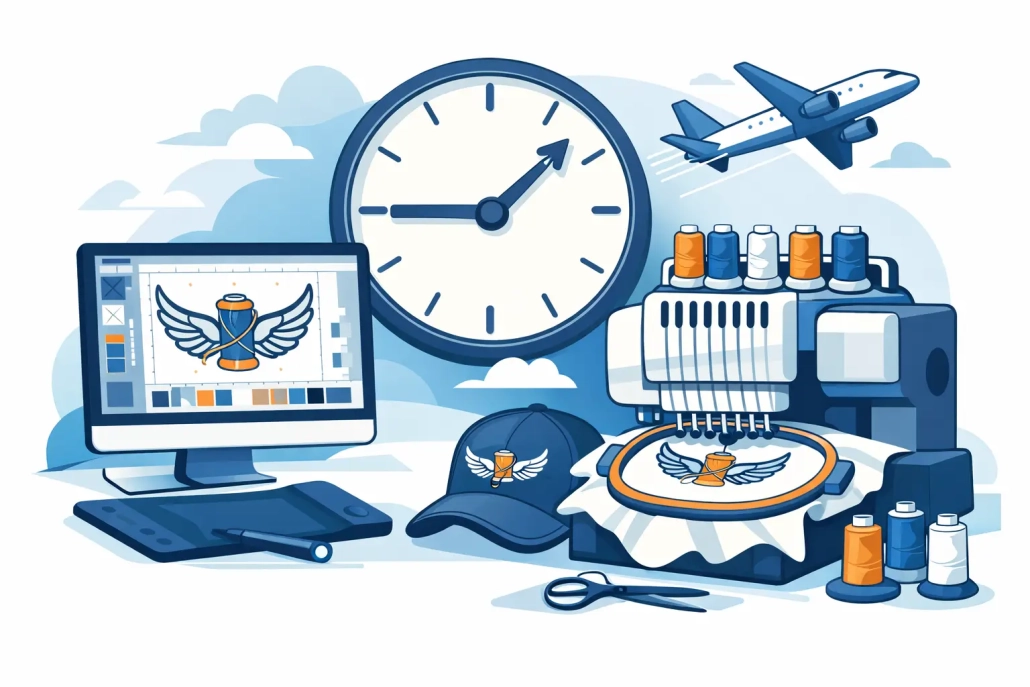
24 Hour Embroidery Digitizing Service
A client approves the logo at 4:30 p.m., the garments are on the floor by 8:00 a.m., and your machine cannot run a JPG. That gap between artwork approval and production is where a 24 hour embroidery digitizing service earns its keep. For shops that live by customer deadlines, rush events, and repeat reorder schedules, fast digitizing is not a bonus. It is part of staying profitable.
The real issue is not just speed. It is whether the file you receive is clean, balanced, and ready to sew on the actual item being decorated. A fast file that causes thread breaks, poor coverage, push-pull distortion, or ugly small text can cost more than the hours you saved. That is why experienced decorators look for turnaround and stitch quality together.
Why a 24 hour embroidery digitizing service matters
Embroidery production runs on timing. Blank goods arrive late, approvals come in after business hours, and client expectations do not slow down because your in-house digitizer is booked. When digitizing becomes a bottleneck, every downstream step gets squeezed – hooping, sampling, production, packing, and delivery.
A dependable 24 hour embroidery digitizing service gives shops room to keep selling without overloading internal staff. It supports the practical reality of custom apparel: left chest logos for corporate wear, cap files for promo orders, jacket backs for team gear, patches for branding programs, and specialty items that need more than a quick auto-conversion.
For many businesses, this is less about emergency rescue and more about workflow design. If your shop handles steady daily orders, outsourced digitizing can be the difference between predictable production and constant schedule compression.
Speed is useful only when the file is production-ready
A digitized design has one job: run well on the machine and look right on the finished product. That sounds simple, but embroidery is not just tracing art into stitches. Every material, stitch type, underlay choice, density decision, and sequence adjustment affects the result.
A left chest logo on a pique polo behaves differently than the same design on a structured cap. A towel needs handling for nap and texture. A jacket back introduces scale, travel path, and registration concerns. A patch design may need cleaner borders, better edge support, and more controlled stitch flow. Fast service only matters if the digitizer understands those differences before the file reaches your machine.
This is where professional digitizing separates itself from bargain shortcuts. The goal is not to generate stitches as quickly as possible. The goal is to create an efficient file that sews cleanly, minimizes production issues, and protects your margin.
What buyers should expect from a serious turnaround partner
If you are shopping for outsourced support, look beyond a broad promise of “same day” or “next day.” A real production partner should be clear about what happens under deadline pressure and what types of files they handle best.
Turnaround time should be specific, not vague. Many standard designs can move much faster than 24 hours, especially common business logos, cap files, and left chest embroidery. At the same time, complex artwork, oversized jacket backs, and highly detailed patch layouts may need a little more care. The right provider tells you when a file is straightforward and when it needs extra attention.
Pricing should also be predictable. Shops managing multiple orders do not want to renegotiate every simple logo. Flat-rate structures on common design categories make planning easier and help you quote clients with confidence. That matters when you are balancing decorator margins, reorder volume, and customer expectations.
Support availability is another practical factor. Orders do not arrive only during office hours. If your team works evenings, weekends, or holiday production windows, access to responsive service matters just as much as technical quality. Quick communication can prevent small artwork questions from turning into missed ship dates.
Where fast digitizing helps most
The biggest gains usually show up in repeat-heavy and deadline-sensitive environments. Embroidery shops and apparel decorators often need overflow support when incoming jobs outpace in-house capacity. Promotional product suppliers need logos converted quickly so branded merchandise can move to approval and production. Print shops adding embroidery services need reliable outside expertise without building a full digitizing department.
Fashion brands and small businesses also benefit when they want scalable support without hiring for a specialized technical role. Digitizing is skilled production work. It takes software knowledge, stitch judgment, and application-specific experience. Outsourcing gives growing businesses access to that capability without carrying the full internal cost.
For agencies and brand managers, speed supports consistency. If logos are digitized properly the first time, reorders become easier, vendor coordination improves, and branded apparel programs stay on track.
The trade-off: rush speed versus file complexity
Not every job should be rushed in the exact same way. That is the honest part of this conversation.
Simple logos with clean shapes and readable text are ideal for fast turnaround. These jobs benefit most from a responsive production team because the path from artwork to stitch file is efficient. More complex art can still be turned quickly, but the expectations should match the design. Tiny details, gradients translated into stitch effects, distressed artwork, and oversized layouts require decisions that affect sewability.
That does not mean you cannot request speed. It means a good service will make smart production choices instead of forcing impossible detail into the embroidery. Sometimes that means simplifying an area, adjusting lettering, or recommending a better stitch treatment for the garment. Those choices protect the final result.
For buyers, this is a good sign. You do not want a digitizer who says yes to everything and leaves your operators to deal with the consequences.
A 24 hour embroidery digitizing service should reduce production stress
The best outsourced support does more than send back a file. It reduces friction across your workflow.
That starts with file readiness. The design should be assigned with the intended application in mind, whether that is cap embroidery, flat goods, towels, patches, or large-format jacket backs. It should also be built for efficiency, so your machines are not wasting motion or creating avoidable trim and registration issues.
It also shows up in communication. If artwork quality is poor, the service team should flag it. If a logo will not sew well at the requested size, they should say so before production starts. If a file can be completed in a few hours instead of making you wait until the next day, that responsiveness has real value.
Companies like UltraEMB stand out in this area because they are built around production support, not one-off design experiments. For busy shops, that matters. You need a partner that understands volume, deadlines, and the commercial side of apparel decoration.
What to look for before sending your next order
When you test a provider, do not judge them only by how fast the email arrives. Judge them by what happens after the file hits the machine.
Look at stitch clarity in small lettering. Check fill consistency on challenging fabrics. Watch whether the file runs smoothly or creates unnecessary stops. Pay attention to how caps, jackets, towels, and patches are handled, because those applications reveal whether the digitizer is thinking like a production specialist or just converting shapes on a screen.
You should also notice whether pricing and service stay consistent over time. A reliable vendor is valuable not because they save you once during a rush, but because they become part of a repeatable system. That is where outsourcing starts to improve capacity, quoting speed, and customer retention.
If your business depends on quick approvals, overnight scheduling, or handling more orders without adding internal overhead, a 24 hour embroidery digitizing service is not just convenient. It is a practical way to protect deadlines and keep quality under control. The right partner gives you more than speed. They give you confidence to say yes to the next job.
 +1 (208) 473-5575 Extension #800
 +44 191 308 5011
 designs@ultraemb.com


Leave a Reply
Want to join the discussion?Feel free to contribute!