
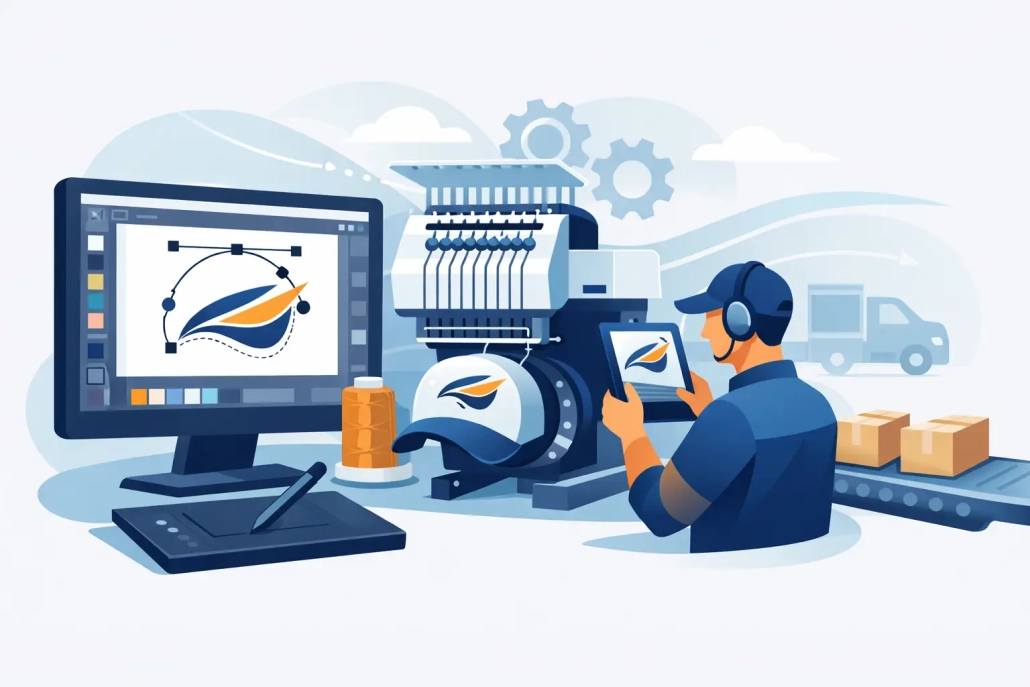
Logo Digitizing Services That Keep Production Moving
A delayed stitch file can stall an entire production schedule. When a customer is waiting on polos, caps, jackets, or patches, logo digitizing services are not a back-office extra – they are a direct part of how embroidery shops protect deadlines, quality, and profit.
For growing decorators and established production teams alike, the real question is not whether digitizing matters. It is whether your digitizing partner can keep pace with order volume, garment variation, and customer expectations without creating avoidable revisions. That is where service quality starts to separate average vendors from real production support.
What logo digitizing services actually do
Logo digitizing services convert artwork into a machine-readable embroidery file. That sounds simple until the design has small text, layered shapes, gradients, thin outlines, or has to run cleanly across different materials. A good digitized file does more than trace a logo. It controls stitch type, direction, density, pull compensation, underlay, sequence, and pathing so the finished embroidery looks balanced on the actual product.
That distinction matters in production. A file that looks acceptable on a flat sample can still fail on a structured cap, a textured towel, or a stretchy performance polo. Digitizing is not just file conversion. It is production planning built into stitches.
For B2B buyers, that translates into fewer machine issues, cleaner runs, better sew-outs, and less time spent fixing preventable problems on press day.
Why apparel decorators outsource logo digitizing services
Most embroidery businesses do not struggle because they lack orders. They struggle when artwork preparation becomes a bottleneck. In-house digitizing can work for some operations, but it also adds labor cost, training needs, software expense, and capacity limits. If your team is already managing quoting, approvals, machine scheduling, and customer communication, digitizing can easily become the part of the workflow that slows everything down.
Outsourcing logo digitizing services gives shops a way to scale without adding internal overhead. It also gives production managers access to specialists who handle different applications every day, from left chest logos and cap fronts to oversized jacket backs and patch borders.
Speed is part of the value, but not the only part. Predictable turnaround, flat-rate pricing on common design types, and support outside regular business hours matter just as much when customers send art late in the day or need revisions before a morning run.
What separates strong logo digitizing services from cheap file conversion
Price always matters, especially in contract decoration and competitive retail fulfillment. But the lowest price per file is rarely the best value if the result leads to thread breaks, poor coverage, distorted lettering, or multiple revisions.
Strong logo digitizing services are built around production accuracy. That means the digitizer is thinking about fabric behavior, stitch travel, cap center-out sequencing, push and pull, and how design details need to be simplified for embroidery. Not every logo can be reproduced exactly as printed artwork. A reliable service knows where to preserve brand integrity and where to adjust for stitch reality.
Communication also matters more than many buyers expect. If a design has elements that are too small to sew cleanly, the right partner explains the issue early and offers a practical path forward. That is better than sending back a technically completed file that performs poorly on the machine.
Capacity is another factor. Small vendors may do excellent work on light volume, then struggle when order flow spikes. If you handle seasonal programs, teamwear, corporate apparel, or promotional drops, you need logo digitizing services that can absorb volume without sacrificing consistency.
Logo digitizing services for different embroidery applications
Not every design should be digitized the same way. One of the most common mistakes in outsourced workflows is assuming a file built for one placement will run equally well everywhere.
Left chest logos
Left chest embroidery is common, but not always easy. Space is limited, and many brand marks include taglines or fine details that do not scale down well. Good digitizing for left chest use often means controlled simplification. The goal is to keep the logo recognizable while making sure it sews cleanly at production size.
Cap designs
Caps create a different set of rules. Structured fronts, center seams, and curved surfaces require sequencing that supports clean registration. Cap files usually need a different approach than flats. Shops that run headwear regularly already know that using the wrong file here can show up immediately in sew quality.
Jacket backs and large formats
Large embroidery introduces its own challenges. Stitch count rises quickly, pathing becomes more important, and poor planning can create unnecessary trims, puckering, and excessive run times. Large-format files need to look good, but they also need to run efficiently.
Towels and patches
Textured surfaces and edge definition change the game again. Towels need enough support to keep stitches from sinking, while patches depend on clean borders and disciplined sequencing. A vendor that understands these applications can save considerable production time and material waste.
How fast turnaround affects your business
Turnaround time is not just a convenience metric. In a production environment, it affects quoting confidence, scheduling flexibility, and customer retention. When you can get quality stitch files back in a few hours instead of waiting days, you can accept more rush work, answer approval requests faster, and keep machines running instead of idle.
That said, speed without control is not useful. A rushed file that needs multiple corrections costs more than a slightly slower file that runs right the first time. The best logo digitizing services combine both – quick delivery and disciplined technical execution.
This is why many decorators prefer a partner with 24/7 coverage and a high-volume workflow. Orders do not always arrive during ideal hours. When art comes in after dinner and the job is scheduled for the next day, responsiveness becomes part of production capacity.
What buyers should look for before placing repeat orders
If you are vetting logo digitizing services for ongoing use, look beyond the first sample file. A single good result is helpful, but repeatability is what matters in business.
Start with consistency. Can the provider maintain quality across standard logos, detailed artwork, cap files, and larger designs? Then look at pricing transparency. Flat rates for common categories make estimating easier and remove friction from repeat ordering. Support is another major factor. If revisions are needed, do you get a fast, clear response, or do jobs disappear into a queue?
It also helps to evaluate whether the service understands commercial pressure. B2B buyers do not need vague creative language. They need files that sew well, pricing that stays reasonable, and communication that respects production timelines.
A provider like UltraEMB fits that expectation when the priority is fast turnaround, affordable rates, and around-the-clock support for embroidery businesses that need dependable outsourced execution.
The trade-offs to keep in mind
There is no single perfect setup for every shop. Some businesses prefer in-house digitizing for full creative control, especially when they handle highly specialized branding or constant same-day edits. Others gain more by outsourcing because the labor and software costs of building an internal team do not make financial sense.
It also depends on order mix. If your business mainly runs simple left chest logos, your needs may center on speed and pricing. If you handle premium caps, outerwear, and custom patches, technical specialization becomes more valuable. The right partner should match your production profile, not just offer a generic promise.
Another trade-off is revision tolerance. The cheapest vendor may be fine for straightforward art, but complex files often need a more experienced digitizer who can anticipate material behavior before the sew-out stage. Paying slightly more for that judgment can lower total production cost.
Why reliable logo digitizing services support growth
As an embroidery business grows, artwork complexity and customer expectations usually grow with it. More clients want brand consistency across multiple garment types. More orders arrive with tighter deadlines. More jobs involve adapting one logo for caps, polos, jackets, and promotional items.
Reliable logo digitizing services give shops room to grow without letting pre-production turn into a weak spot. They help teams quote faster, produce more confidently, and maintain standards across product categories. That operational stability matters whether you are running a local embroidery shop, a regional contract decorator, or a branded merchandise supplier managing ongoing client programs.
The best outsourcing relationships do not feel like outsourcing at all. They feel like having a skilled production resource ready when the workload spikes, the artwork gets tricky, or the deadline leaves no room for delay.
If your machines are ready but your art pipeline is slowing you down, that is usually the clearest sign that better logo digitizing services can do more than improve stitch files – they can make the whole business easier to run.
 +1 (208) 473-5575 Extension #800
 +44 191 308 5011
 designs@ultraemb.com


Leave a Reply
Want to join the discussion?Feel free to contribute!